
Maker Faire Tokyo 2026 was held on September 5–6 at Ariake GYM-EX, a new venue for the event. Until last year, it had been held at Tokyo Big Sight. This time, Maker Faire occupied one large hall of its own, with a high ceiling and a much more open layout.
I was exhibiting as well, so I had the useful privilege of walking around before the doors opened. I recorded almost the entire walk and turned it into a 30-minute video.
Watch the full Maker Faire Tokyo 2026 walkthrough:(Please change to English subtitle)
This post is not an attempt to turn every booth in the video into text. Maker Faire is particularly bad for that: once you start listing projects one by one, the interesting part disappears. Instead, I want to use some of the projects I saw to describe what felt different about Maker Faire Tokyo this year.
Last year, I wrote that Tokyo might be the best Maker Faire in the world — but that fewer people felt they could exhibit there
Last year I visited six Maker Faires in Seoul, Tokyo, Rome, Shanghai, Shenzhen and Taipei, and wrote a comparison of them.
https://note.com/takasu/n/nac0d9f9cc0b5
My conclusion about Tokyo was fairly simple. The quality of the projects was extraordinarily high. That did not mean only technical sophistication. It included the ideas, presentation, art, university projects, startups, strange personal experiments, communities such as Hebocon, and things that do not fit any obvious category.
I still think Maker Faire Tokyo is one of the highest-level Maker Faires in the world.
But I also wrote about a problem. The space at Tokyo Big Sight had become smaller over the years, and I increasingly heard younger people who had never exhibited say that Maker Faire Tokyo was somewhere you went to see things, not somewhere you imagined exhibiting yourself.
That worried me more than whether the exhibits were technically impressive. Maker Faire matters because making remains something participants can imagine doing themselves.
This year’s move to Ariake GYM-EX does not automatically solve that issue, but the physical situation has clearly changed. The hall feels more spacious, individual booths seem to have more room, and larger projects are easier to accommodate.
You can see the difference almost immediately in the video.
00:05 — Entering the new Ariake GYM-EX venue
00:14 — One large hall dedicated to Maker Faire
18:56 — The event and individual booths feel larger this year
The number of booths did not seem dramatically different from last year. What changed was the amount of space around them. I hope this eventually makes it easier to accept more people and more ambitious physical projects, rather than simply making the same exhibition more comfortable.
Some of the DIY projects now look like startup products
One advantage of being an exhibitor is being able to walk around before the crowd arrives. Near the entrance, Seeed Studio had LeKiwi, SO-101 and other robotics projects.
01:06 — Seeed Studio’s robotics area
A little further on, I saw a robot that I first assumed came from a startup. It could be controlled by teleoperation, and the mechanical design and overall finish were surprisingly complete.
It was a DIY project.
01:47 — A DIY robot that looks like a commercial product
Inside it was an M5Stack Atom.
02:14 — M5Stack Atom inside the DIY robot
This kind of project is common enough at Maker Faire Tokyo that it stops feeling unusual after a while. In some other ecosystems, once a project reaches this level of finish, the next step is often to form a company and present it as a product. In Tokyo, many technically sophisticated projects remain projects.
That is not necessarily better or worse. It is one characteristic of the local maker culture.
The same space also contains things with completely different motivations. A steam catapult launches paper airplanes in a project called CV-0 Divergence.
02:40 — Launching paper airplanes with a steam catapult
Nearby are long-running communities such as Tsukuru-mu Ebina and Sugoi Lab. Seeing the same people return with new work each year is another reason to attend Maker Faire repeatedly. The event is not only a snapshot of projects; it lets you see projects and communities change over time.
A 4-bit CPU programmed with Gemini
Professor Akita from Kanazawa University was exhibiting again after being away from Maker Faire Tokyo for some time. One of his projects used a TD4, a famously minimal 4-bit CPU familiar to Japanese electronics hobbyists.
The chip itself was exposed and embedded in resin.
03:08 — The exposed 4-bit TD4 CPU
More interestingly, the 4-bit computer was running a line-following robot.
03:22 — Line tracing with a 4-bit CPU
And the program had been written with Gemini using what we now call vibe coding.
03:29 — Using Gemini to program the TD4 project
A very old and extremely constrained computing architecture meets a large language model in order to make a tiny robot follow a line. Discussions about generative AI tend to become discussions about huge software platforms very quickly. At Maker Faire, somebody simply connects the newest technology to an old 4-bit CPU to see what happens.
A few booths later, I found something from an even earlier generation of computing: magnetic-core memory rebuilt as a USB device.
04:38 — A 128-byte USB magnetic-core memory
The capacity is only 128 bytes, and the circuit board is enormous. But it works as memory connected to a modern computer.
Instead of putting old technology behind glass and explaining it, the maker rebuilt it into something that can actually be used. I like this approach to technical history much more.
M5Stack is moving out of the electronics-project category
Because I work with M5Stack, I inevitably notice it everywhere. What interested me this year, however, was not the number of projects using M5Stack. It was how they were using it.
In many cases, M5Stack is no longer the subject of the project.
It is simply a component inside a robot, mobility device, agricultural machine or coffee machine.
06:19 — Another machine using M5Stack
12:21 — M5Stack appearing throughout the venue
M5Stack itself also had a booth with new products and limited items.
12:29 — M5Stack’s official booth
But the project that interested me most was not at the official booth. It was a homemade sorting and weighing machine.
15:35 — A DIY sorting and weighing machine built with M5Stack
The maker explained that it could be built much more cheaply than purchasing a commercial machine. A single unit was relatively slow, so the solution was simply to run four units in parallel. If more throughput is required, more units can be added.
15:54 — Instead of one fast machine, use four inexpensive machines
This is very close to the developer-centric approach I have been researching. Rather than buying one expensive, highly specialized system, increasingly capable general-purpose hardware allows the person who understands the actual problem to build a machine appropriate for that specific workplace.
In the video I called it a kind of hardware version of end-user development.
16:14 — “Hardware end-user development”
A few minutes later I followed the smell of coffee and found an automated barista controlled with M5Stack.
16:51 — An automated barista controlled by M5Stack
Once these devices start appearing inside agricultural equipment and coffee machines, describing them simply as “electronics development boards” becomes increasingly misleading.
Individual makers seemed slightly fewer, while real-world applications increased
This was probably the most important change I felt while walking through the venue.
There seemed to be slightly fewer of the traditional individual makers than in earlier years. At the same time, there were more projects clearly aimed at solving real problems or eventually being used outside Maker Faire.
An open-source powered suit was one example.
10:57 — An open-source powered suit
Another project used AI vision to identify the ingredients in shichimi, a Japanese seven-spice mixture, and automatically sort them on a conveyor.
11:24 — AI vision sorting shichimi ingredients
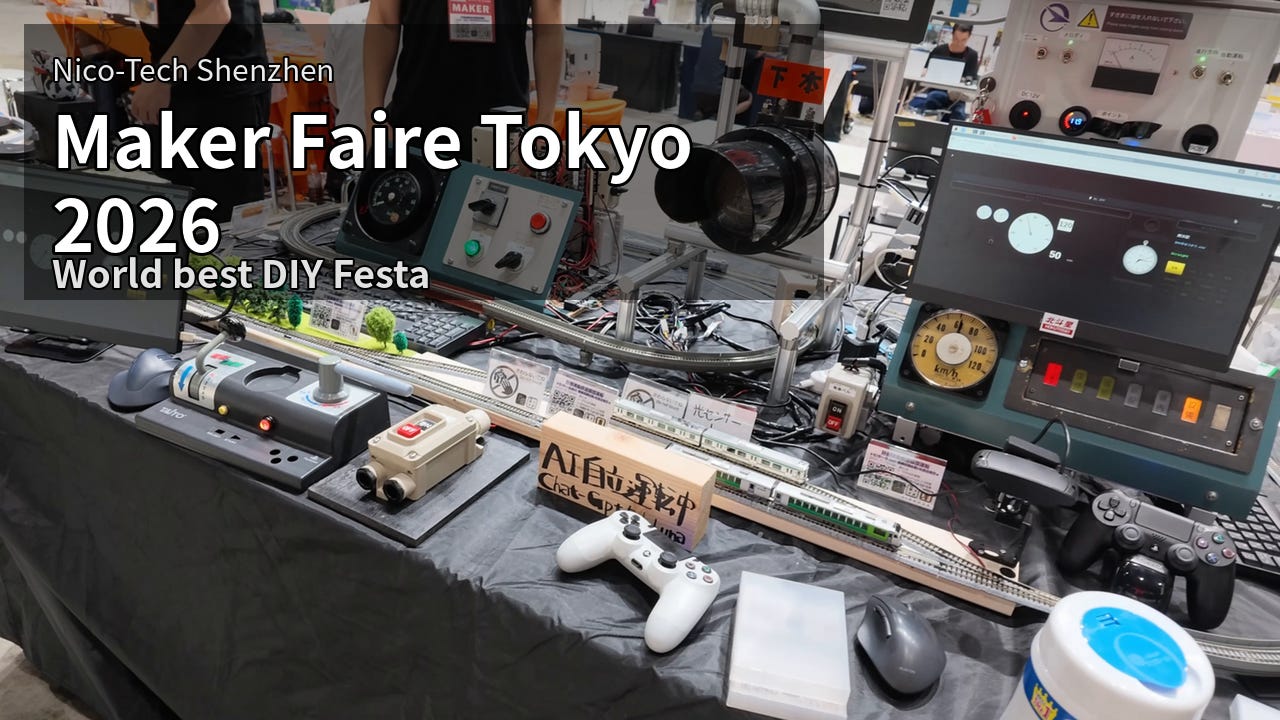
There was an autonomous model railway using AI, including an actual railway control interface visitors could operate.
11:57 — AI autonomous model railway
Another project was an assistive piano for people with limited hand movement. The keyboard itself helps follow the performance and supplies notes as needed.
17:58 — An assistive piano where the instrument helps the performer
And there was a bicycle navigation system that does not simply depend on smartphone GPS. It combines wheel sensors, barometric pressure, IMU data and other measurements to improve its position estimate when GPS becomes unreliable.
20:09 — A bicycle navigation system built from the sensing layer up
I do not think this means Maker Faire Tokyo has simply become more commercial.
Many of these projects are not startups. Some may never become mass-produced products. They are closer to a person encountering a real problem and now having enough accessible technology—microcontrollers, sensors, 3D printing and increasingly AI—to build a serious solution themselves.
The distance between “DIY project” and “something that can actually be used” is getting shorter.
That is different from commercialization.
Not everything needs to be useful
At the same time, I think it is important that Maker Faire does not become an exhibition of practical applications.
There is a huge wooden Gatling gun that fires rubber bands.
21:09 — Giant wooden rubber-band Gatling gun
There is an instrument made by attaching piezo sensors to pasta.
25:09 — Making music with pasta and piezo sensors
Earlier in the video, someone is working on something called the “Roulette That Controls Your Life,” with a new dart machine under development beside it.
04:24 — The Roulette That Controls Your Life
The sound projects were particularly good this year. One installation directly connects physical movement to changing sound.
22:37 — Physical control directly changing sound
Another uses inexpensive mass-produced components but produces remarkably good audio, while letting you follow the changing waveform in real time.
22:58 — Cheap components, unexpectedly good sound
Then there is what I described as a one-person DJ system, where the visual interface and sound are linked.
24:02 — A one-person physical DJ interface
I think the coexistence of these two directions is important. Accessible technology is allowing individuals to make increasingly practical machines, but the same tools also make it easier to build things that have no obvious reason to exist.
A healthy maker event should contain both.
If every project has to begin by answering “What problem does this solve?”, we will lose many of the experiments that later create entirely new uses.
If individual makers are decreasing, what does that actually mean?
Near the end of the walk, I say in the video that individual makers seem to have decreased slightly, while projects closer to social implementation have increased.
25:53 — Individual makers and the growth of real-world applications
I do not think the right conclusion is simply that Maker Faire has become corporate.
The boundaries have changed.
KadoMakers from Osaka, for example, is a community of makers inside companies.
27:12 — KadoMakers, a community of makers working inside companies
People have always built things outside their official job descriptions. What may be changing is that companies are increasingly willing to recognize those people and communities publicly.
The same is true for universities, educational programs and projects with specific users in mind. Maker activity has spread into more organizational forms.
So the question is not only whether the number of traditional individual booths has gone up or down. It is also where making is happening now.
Despite that change, the density of ideas and expression at Maker Faire Tokyo remains extremely high. This is the part that, in my experience, still separates Tokyo from many other Maker Faires.
I asked an overseas guest what he thought of this year’s event.
26:36 — Asking an overseas visitor about Maker Faire Tokyo
His answer was that it was better than last year: there were many good makers, the technology had improved, and the DIY projects had improved as well.
That was close to my own impression.
The risk is that this very high level makes the event intimidating for people who have never exhibited. A bigger venue helps with the physical limitation, but it does not automatically solve the cultural one. I still think Maker Faire needs to remain a place where a first-time maker can imagine showing something next year.
Look at what teenagers are actually building
Toward the end of the video I visited Mitou Junior, a Japanese program supporting creators aged 17 and under.
27:57 — Mitou Junior
One project used LCD displays inside physical mahjong tiles.
28:16 — Digital displays inside physical mahjong tiles
The interesting part is that the maker did not replace mahjong with an app. The physical shape and feeling of the tile remain, while digital behavior is added on top.
I often hear big questions about what AI will do to society, what robotics will change, or what the next computing platform will be. Those discussions have value, but looking at what a teenager has actually built often tells me more about the future.
By the time a technology becomes a large news story, it has already become a company, a market or a policy issue. Before that happens, somebody is experimenting with it at home, in a lab or at a local community space.
Maker Faire lets you see a large number of things at that earlier stage.
Last year, after visiting six Maker Faires, I wrote that if you want to understand where a country may be going, watching its robot competitions and Maker Faires is probably a good place to start.
I still think so.
Maker Faire Tokyo 2026 felt a little larger. The projects felt a little closer to actual deployment. Individual makers may have been slightly fewer, but the density of ideas remained exceptionally high.
And, importantly, there were still people building pasta instruments and giant rubber-band guns.
That balance is worth keeping.
Watch the complete 30-minute Maker Faire Tokyo 2026 walkthrough:
For more detailed field notes in Japanese, I also keep a paid Shenzhen / Mass Innovation Field Notes magazine here:
https://note.com/takasu/m/m55763d81ba8e