
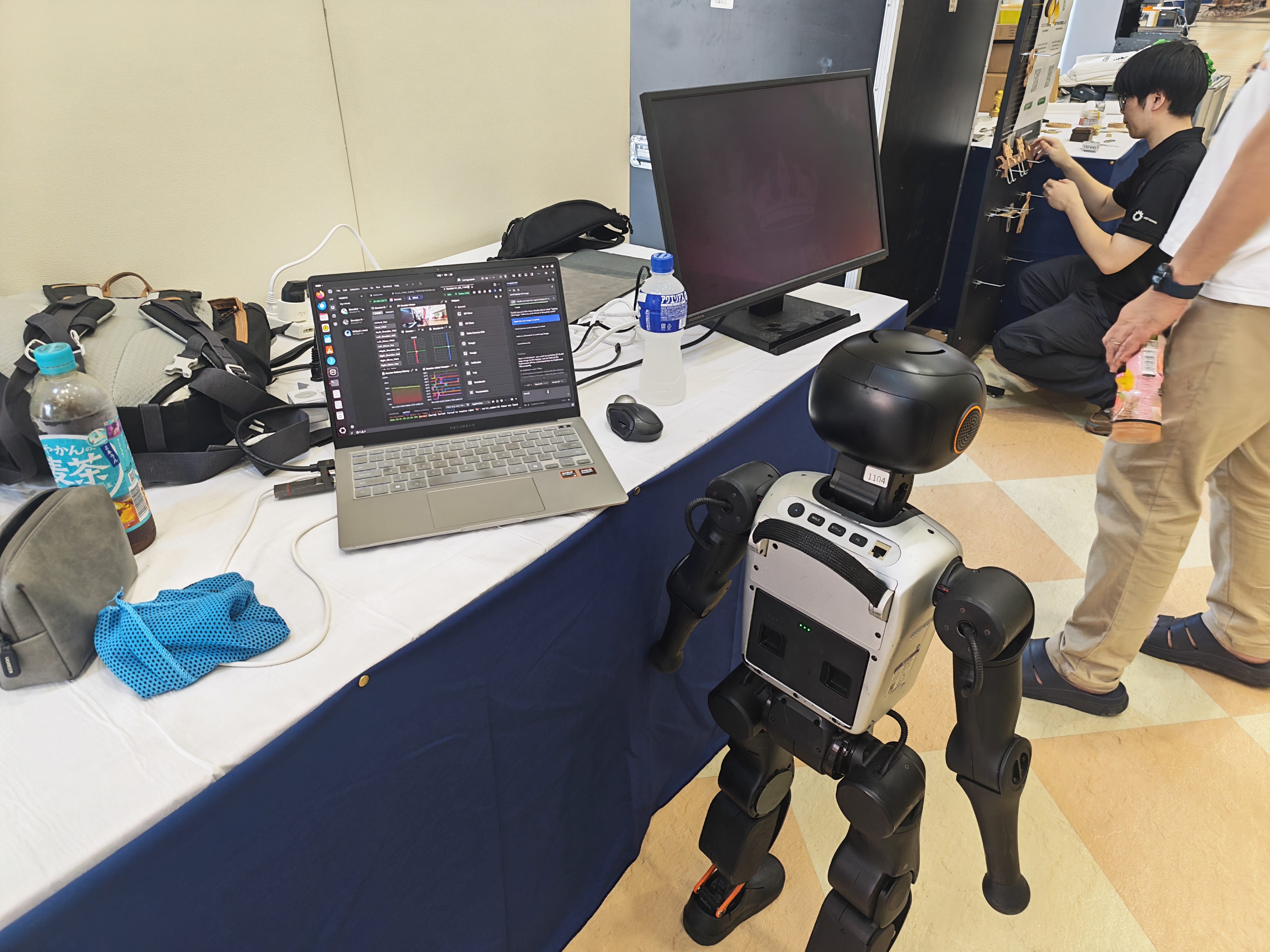
I’ve been exhibiting at the Robotics Society of Japan Annual Conference (#RSJ2026), where we have a Booster Robotics K1 humanoid robot at our booth.
During breaks between demonstrations, I started experimenting with it myself.
After three days, my impression is that the K1 is not only a capable humanoid robot. It is a surprisingly good development platform.
And I think it reflects something broader that I have been seeing in recent technology products coming out of China.
From first contact to my own robot application in a day
The K1 comes with Booster Studio, which lets you inspect the robot’s state, including its camera and depth-camera data.
You can also write Python programs and deploy them to the robot.
On my first day, I managed to get my own code running on the physical K1.
By the second day, I had built a simple interactive demo: when the system recognizes a face, the robot raises its hand.
That is a remarkably short path from opening the development environment for the first time to making a humanoid robot do something that was not part of its original demo.
ROS 2, MuJoCo, and the real robot
The development environment is not isolated from the wider robotics ecosystem.
The K1 can be used with ROS 2 and MuJoCo, allowing developers to work with simulation as well as the physical robot.
I have also been experimenting with getting motor-state information from the real K1 and connecting that work with MuJoCo.
This matters because developers do not have to learn an entirely proprietary world just to start experimenting with the robot. They can work with tools and concepts that are already widely used by the robotics community.
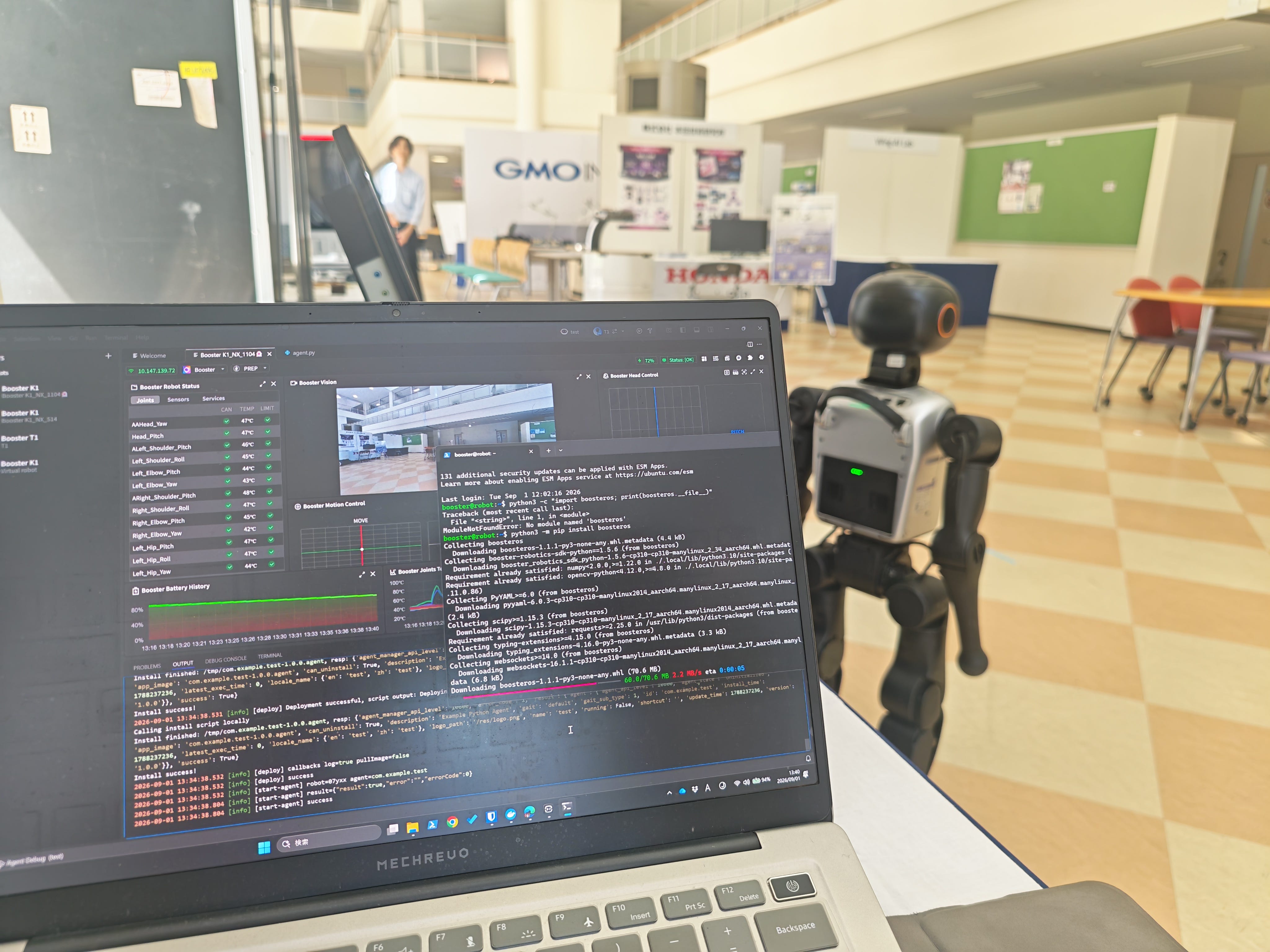
I did this after three days
Perhaps the most interesting part is who wrote these programs.
Me.
I’m in my 50s, and my original academic background is in the humanities. I am certainly not someone who has spent decades writing humanoid robot control software.
Yet within three days of touching the K1 for the first time, I was building interactive demonstrations and writing programs to work with motor data for MuJoCo.
AI coding tools helped enormously.
But saying “AI wrote the code” misses an important point.
AI can only help effectively when the platform gives it something good to work with.
Booster provides documentation and sample code through its official website and GitHub repositories. It uses technologies such as Python and ROS 2 that already have enormous amounts of documentation, examples, and community knowledge available.
This makes a huge difference when working with an AI coding agent.
Instead of explaining an obscure proprietary SDK from scratch, I can point the AI toward the official documentation and existing examples, describe what I want the robot to do, generate code, test it on the robot, and iterate.
Something I increasingly notice in Chinese technology products
This experience with Booster reminds me of something I have increasingly noticed in recent Chinese technology products.
The interesting companies are not simply putting advanced technology into their products.
They are getting better at understanding how high technology, open source, and developer ecosystems work together.
Supporting ROS is one example. Publishing usable sample code is another. Providing documentation in formats that developers — and now AI coding agents — can easily read is becoming increasingly important.
And the better companies do not merely consume open-source software. They participate in existing technical ecosystems, contribute back to them, and build their products around standards and tools developers already know.
This is quite different from the older model of hardware development, where a manufacturer might ship an impressive piece of hardware together with a proprietary SDK, a PDF manual, and a handful of examples.
In the age of AI coding, documentation and openness have become part of the product itself.
Good documentation is no longer only for humans.
Sample code is no longer only a tutorial.
Standard APIs and open-source repositories are becoming interfaces through which both humans and AI understand a machine.
That changes what “developer-friendly hardware” means.
A different benchmark for humanoid robots
Humanoid robots are usually compared by specifications: degrees of freedom, torque, payload, walking speed, battery life, or the sophistication of their demonstrations.
Those things matter.
But after spending three days with the K1, I think there is another benchmark worth considering:
How long does it take a new developer to make the robot do something that wasn’t in the manufacturer’s original demo?
In my case, with the Booster K1, the answer was about a day.
And perhaps that tells us something not only about Booster, but about where a new generation of Chinese technology products is heading.

